“The Government of Vanuatu has formally committed USD25 million, which is approximately VT3 billion in co-financing, for the proposed Malekula Climate Resilient Road Infrastructure Project in MALAMPA Province, marking a significant step towards strengthening climate-resilient and sustainable transport infrastructure on the country’s second-largest island.
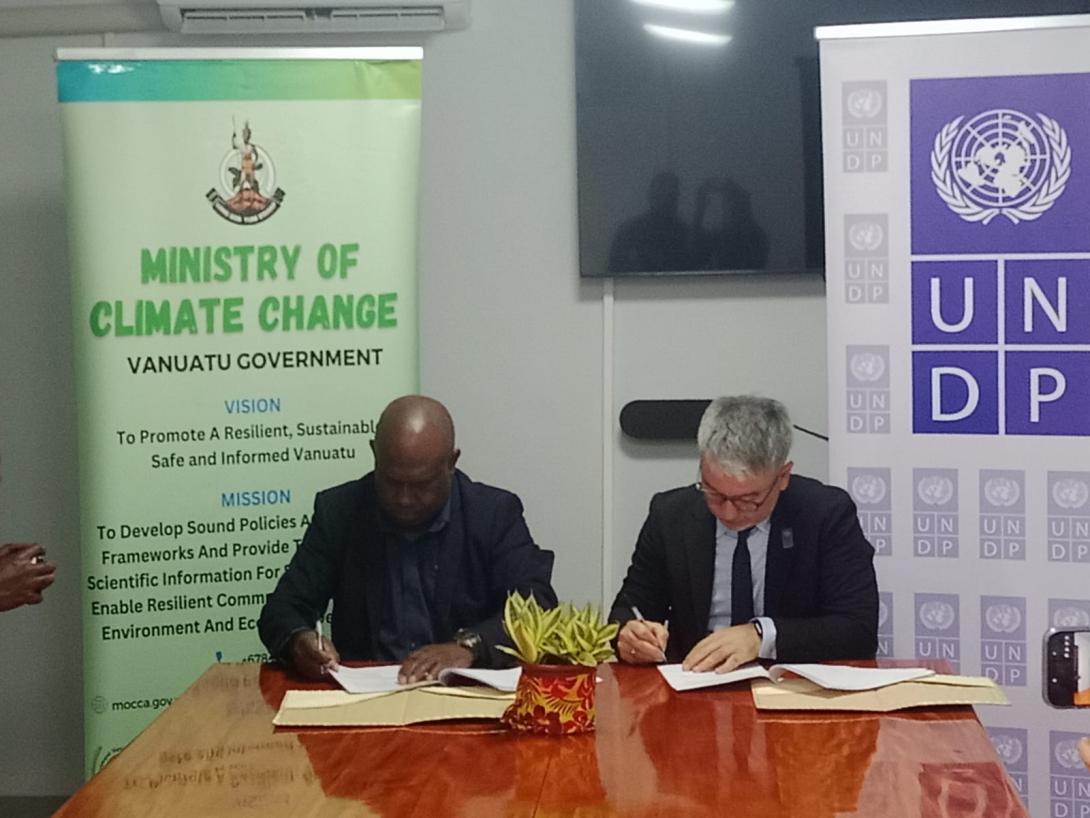
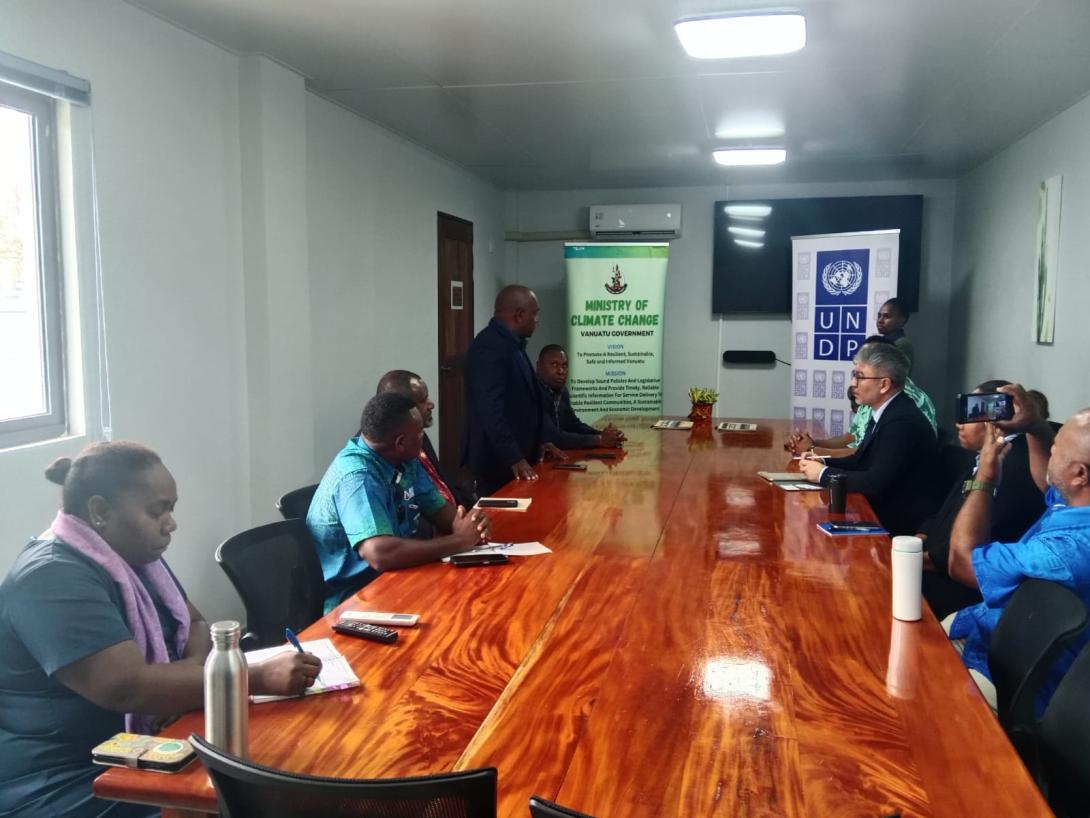
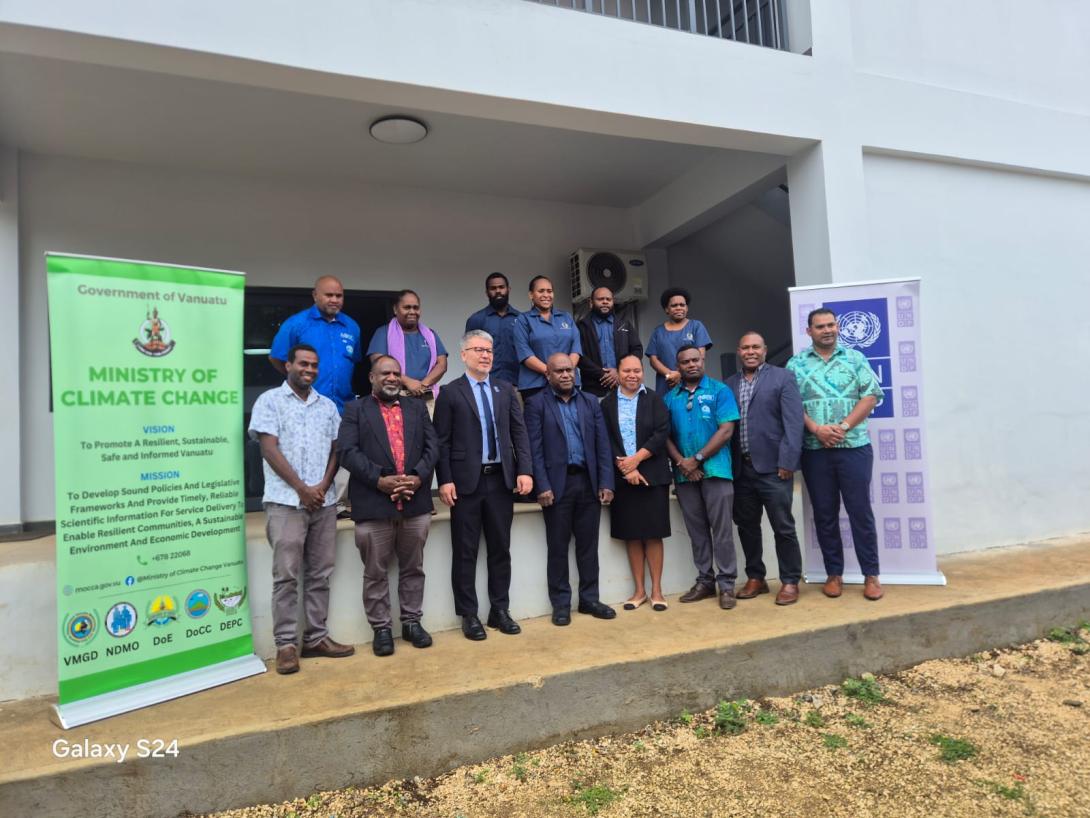
The Government, through the Ministry of Climate Change (MoCC), Meteorology and Hydro-meteorological Services, Geological Hazards, Environment, Energy and Disaster Management, signed a Memorandum of Understanding (MOU) with the United Nations Development Programme (UNDP) yesterday to disburse and administer the cash co-financing under an agreed fiduciary arrangement.
The commitment includes USD20 million, which is approximately VT2.39 billion, in cash contributions and USD5 million, or VT598,631,000, in in-kind support.
The investment demonstrates the Government’s strong commitment to improving connectivity, enhancing resilience to climate impacts and supporting economic opportunities for communities across Malekula.
In response to the Government’s request, UNDP has proposed a phased approach to advance project preparation and financing arrangements.
The first phase focused on finalising and signing the MOU, enabling the receipt of an initial co-financing disbursement tranche in March 2027.
This commitment is complementary to a USD3 million grant, or VT358 million, jointly mobilised by the Government of Vanuatu in partnership with UNDP in June 2026 through the Global Environment Facility (GEF).
Following this, UNDP will support the mobilisation of a qualified firm to undertake a Pre-Feasibility Study. The study will assess the technical, economic, environmental and financial viability of the proposed road infrastructure investments and help inform subsequent project design and financing decisions to support the mobilisation of additional grant resources already earmarked with the Adaptation Fund and the GEF, as well as a concessional facility through the Green Climate Fund (GCF).
Concurrently, UNDP will assess institutional options for pursuing the concessional loan component, including potential partnerships with accredited entities such as the Asian Infrastructure Investment Bank (AIIB) or the United Nations Capital Development Fund (UNCDF), as well as options for direct sovereign borrowing by the Government of Vanuatu.
Director General (DG) for the MoCC, David Gibson, said the Government’s substantial co-financing commitment reflects the importance of climate-resilient infrastructure for Vanuatu’s long-term development and resilience agenda.
He said investment in resilient roads is critical to ensuring reliable access to essential services.
“The agreement is to start building a resilient road on the island of Malekula. The agreement is legally binding,” he said.
Mr. Gibson said the Malekula project is not the first resilient infrastructure project.
He said UNDP has already funded resilient feeder roads on the island of Tanna.
UNDP Deputy Resident Representative for the Pacific Office, Abduvakkos Abdurahmanov, said the proposed phased approach will help establish a strong evidence base for investment decisions while ensuring that financing arrangements are aligned with national priorities and international standards.
Mr. Abdurahmanov said through this process, UNDP remains committed to supporting the Government of Vanuatu to develop resilient infrastructure solutions that strengthen climate adaptation and deliver sustainable benefits for communities.
“We are extremely proud to be here in Vanuatu and partnering with the Government of Vanuatu, the Ministry of Climate Change on a new initiative on the Malekula Climate Resilience Infrastructure Programme. So today we have signed a Memorandum of Understanding and we will be working together with the Government of Vanuatu to start feasibility studies for this very important initiative.
By partnering with the Government, we want to bring in a whole-of-island development concept to this project and ensure that the gains and the benefits of this programme reach the citizens of Vanuatu beyond infrastructure,” he said.
Mr. Abdurahmanov said infrastructure is not an end in itself, but it brings opportunities, and UNDP has several years of experience working on resilient infrastructure in Vanuatu and across the Pacific.
“Specifically on Pentecost Island, we recently completed construction of three pico hydro systems and also do work on smaller-scale infrastructure, community-level infrastructure, making it more resilient and able to withstand potential shocks from natural disasters.
“So, we do have that expertise, and we also want to work with the Government of Vanuatu to ensure that the best Pacific and international practices in resilient infrastructure are mainstreamed into this new programme,” he said.
The Malekula Climate Resilient Road Infrastructure Project is expected to contribute to improved transport connectivity, increased resilience to extreme weather events and enhanced socio-economic opportunities for communities across Malekula, supporting Vanuatu’s broader sustainable development and climate resilience goals.
Prime Minister Jotham Napat recently said that he also wants the same resilient road infrastructure on the islands of Santo and Malo.”
Source & Image: Vanuatu Daily Post
Date of Publication: 22/07/2026
#livinginvanuatu #livinginvanuatunews