The goverment of Vanautu,will organize a Climate Zone Quiz on an anual basis, building on the success and generated intrest of the previous years.
The annual Quiz will be facillitated by the Vanuatu Ministry of Education, USP Vanuatu, the Vanuatu Meteorology & Geohazards Department and SPC-GIZ Climate change
GCCA–Vanuatu consists of two separate components with differing objectives and implementation modes. Component A – the subject of this brief – covers the enhancement of policy development on and institutional strengthening of climate change in Vanuatu. Component B focuses on increasing resilience to climate change and natural hazards and will be implemented by the World Bank through an Administrative Agreement between the European Commission and World Bank (see separate brief on the IRCCNH project).
Strengthening Vanuatu’s voice at UN Climate Talks - Vanuatu’s Government and civil society are working together in Warsaw to ramp up pressure for stronger international climate action
A 16-strong delegation from Vanuatu is at the United Nations Climate Conference in Warsaw this week, where countries are continuing negotiations towards a new global climate agreement.
'Yumi Redi 2', Disaster risk reduction project funded by dipecho and Australian Aid is 18 month project. which aims to support community to be bettter prepared for natural disaster.
The project had already done the baseline, through the baseline we identify the key main areas in which will work specific with community and schools.
'Yumi Redi 2', Disaster risk reduction project funded by dipecho and Australian Aid is 18 month project. which aims to support community to be bettter prepared for natural disaster.
The project had already done the baseline, through the baseline we identify the key main areas in which will work specific with community and schools.
In the scope of the CCA consortium program, the Vanuatu Red Cross society is targeting 11 communities as follow:
- Torres: Hiu Island Yagavegemena community;
- Torres: Toga Island Liteu community;
- Vanualava: Vatop community;
- Motalava: Rah, Nereningman, Queremagde, Totalag and Avar communities;
- Gaua: Qwetevevaeg, Dolav and Ontar communities
In the scope of the "Supporting Community Planning" project, the Vanuatu Red Cross Society is targeting 11 communities (2.500 people) in Torba Province as follow:
- Torres: Hiu Island: Yagavegemena community : HF radio, improvement of evacuation point;
- Torres Toga Island: LIteu & Likwal communities: HF Radio
- Vanualava: Vatop community : HF Radio
- Gaua: Lemanman & Lemoga communities: Imrovment of evacuation point
- Gaua: Qwetevaveg community: HF Radio;
- Motalava: Rah, Nereningman, Queremagde, Totolag, Avar communities: Gravity fed System (acces to safe water)
New Project to Improve Disaster Response for People in Port Vila and Luganville
Vanuatu Government and World Bank launched USD3 Million project to improve disaster response for the 57000 people of Port Vila and Luganville.
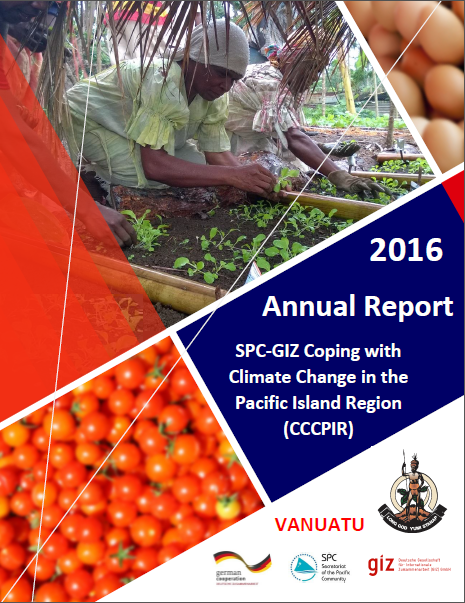
The ‘Coping with climate change in the Pacific Island Region (CCCPIR)’ programme aims to strengthen the capacities of Pacific member countries and regional organisations to cope with the impacts of climate change. The programme is funded by the government of the Federal Republic of Germany through the Federal Ministry for Economic Cooperation and Development (BMZ) and implemented through GIZ working in partnership with SPC and SPREP.
The programme commenced its activities in 2009 working with Fiji, Tonga and Vanuatu. In 2011 the program was expanded to another nine Pacific Island Countries, namely the Federated States of Micronesia (FSM), Kiribati, Marshall Islands, Nauru, Palau, Papua New Guinea, Samoa, Solomon Islands, Tuvalu and the duration has been extended until 2019. The programme brief available at http://www.spc.int/lrd/index.php?option=com_content&view=article&id=478&Itemid=44 gives further details.
At the regional level, the programme aligns with the Framework for Resilient Development in the Pacific (FRDP). The programme will support countries in implementing key strategic priorities in the area of climate change including, where relevant, their Nationally Determined Contributions (NDCs), National Adaptation Programmes for Action (NAPA), National Communications to the United Nations Framework Convention on Climate Change (UNFCCC), and other relevant national strategies, polices and plans.
The overall objective of the programme is that ‘the capacities of regional organisations in the Pacific Islands region and its member states to adapt to climate change and mitigate its causes are strengthened’. This objective will be achieved through six components highlighted below.
Component 1: Strengthening regional advisory and management capacity
Component 2: Mainstreaming climate considerations and adaptations strategies
Component 3: Implementing adaptation and mitigation measures
Component 4: Sustainable tourism and climate change
Component 5: Sustainable energy management
Component 6: Climate change and education
Components 2 and 3 focus on climate change-related aspects in the field of land- and marine-based resources.
A brief presentation outlining the overall programme objectives and indicators is available at http://www.spc.int/lrd/index.php?option=com_docman&task=cat_view&gid=210&Itemid=48
The programme will be guided by nationally determined priorities and will seek to build on and complement existing and proposed initiatives by the national government, SPC and SPREP and development partners involved in providing climate change related assistance to countries.
For further information please contact;
Wulf Killmann Jesse Benjamin
Programme Director Director General
CCCPIR Vanuatu Ministry of Climate Change
The goverment of Vanautu,will organize a Youth and student engagement in climate change, written and oral qui building on the success and generated intrest of the previous years.
The annual Quiz will be facillitated by the Vanuatu Ministry of Education, USP Vanuatu, the Vanuatu Meteorology & Geohazards Department and SPC-GIZ Climate change