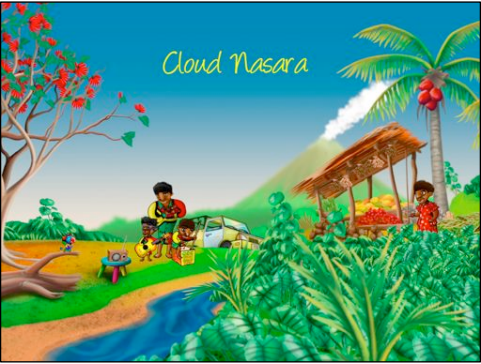
The Cloud Nasara Pacific Climate Animation Project aims to increase awareness of the science and impacts of climate variability in the Pacific, and to provoke discussion around how communities can take ‘low regrets’ actions to prepare for future El Niño and La Niña events and adapt to climate change. Cloud Nasara is an innovative new collaboration between Red Cross and the Australian Government’s Pacific-Australia Climate Change Science and Adaptation Planning Program (PACCSAP). The project is being implemented by the Red Cross, the Australian Bureau of Meteorology, the Commonwealth Scientific and Industrial Research Organisation (CSIRO), the Vanuatu Meteorology and Geo-hazards Department (VMGD) and the SPC-GIZ Climate Change Program.
Two short comical animation films are being developed as communication tools. One film will give an overview of climate processes and impacts in the Pacific region as a whole. The other film will be specifically focused on Vanuatu as a pilot country. They will be accompanied by a comprehensive ‘tool kit’ which will include resources to help facilitators link the information presented in the animation to decision making and action. The Cloud Nasara project is being developed through an ongoing consultative process, which includes research, focus groups, forums and direct communication with key stakeholders in Vanuatu and across the Pacific region. Cloud Nasara will be launched in June 2013. The films and accompanying resources will be useful for organisations, government, schools, and community groups in Pacific countries and by regional bodies across the Pacific and may assist those working in areas such as disaster risk management, health, food security, community planning, and environmental protection.
Contact: Ula Majewski – umajewski@meteo.gov.vu
The Global Framework for Climate Services (GFCS) is based on the philosophy that efficient management of the climatic risks today is the foundation for managing the changed climatic risks of tomorrow. Sound scientific knowledge underpins this foundation. Where they exist, climate services are extremely effective. Prominent user sectors are agriculture, water management, health, disaster risk reduction, planning and energy. But there is a wide gap between the needs for climate services and their current provision in climate-vulnerable developing countries and especially in their communities.
Communities in Vanuatu have always related to the climate and weather in their own context. Being highly exposed to risks of extreme events such as tropical cyclones, flooding and droughts, communities have naturally adapted in their own ways. They are able to use their surroundings to indicate in advance the different weather extremes they are likely to face. These careful observations of their surrounding have allowed them to come up with their own traditional forecasting methods which have been tested and proven to be very reliable.
In parts of the country where communication is still a challenge, communities continue to rely on their knowledge of the environment to guide their preparedness for extreme events. While there is promise in the use of this traditional based science, there are also challenges.
The first challenge comes as a result of modernization and increased emphasis for the use of western science over traditional methods. Modern school systems, urbanization, the growing interest in the cash economy and western goods have left the traditional based knowledge, such as the knowledge to be able to forecast weather and climate using indicators, a thing of the past. It seems to have not yet found its place in the modern society and thus slowly fading away. In some communities, there may be less than a handful of elders left who still hold this wealth of knowledge. This program will hope to document some of the remaining knowledge so they can be reintroduced to the younger generations through vernacular programs in primary schools or preserved in archives.
The second challenge often confronted by the VMGD is to reach out to remote communities to document traditional knowledge. This knowledge in some communities have been used and relied upon for centuries and it formed a vital part of the societal structure. For example, on Tanna Island, the chiefly system setup would have different tupunas who have their own role in the governance structure of a community. In that governance structure, it is a tupunas whose role is to provide weather information to the chief and the people. He would be a weatherman of the community and his role has been predefined over centuries.
The tupunas have found their own niche in these communities and therefore have more authority and effect on people’s decision than a foreign advice that comes from outside institutions such as the VMGD. Communities over the years have naturally followed the advice from tupunas. However, tupunas lack the understanding of the broader science and often in circumstance what they think they know as dictated by century old practice would be contradictory to advice from VMGD.
The century old knowledge has been observed over many years. To communities, the indicators they use from plants and animals are reliable and have guided their activities for many years. Modern forecasting systems on the other hand is based on complex mathematical calculations and proven theories which are also tested and verified. There is a real opportunity to integrate both the centuries old traditional weather and climate forecast system and modern scientific methods in Vanuatu for improved decision making.
NOTE; PROJECT NOT YET ENDORSED BY THE NATIONAL ADVISORY BOARD ON CLIMATE CHANGE AND DISASTER RISK REDUCTION
The Action ‘Generation and adaptation of improved agricultural technologies to mitigate climate change-imposed risks to food production within vulnerable smallholder farming communities in Western Pacific countries’ was a five year partnership between organisations of three Western Pacific Countries and the BOKU in Austria as the main partners. This collaboration was the first of its kind for all partners. In particular it was a first collaboration where the three Western Pacific Countries (including Papua New Guinea and the Solomon Islands ) worked together under its own management to implement an agricultural research for development project of this scale.
Progress to date and current activities:
C-CAP mobilized to the region in November 2012, working primarily to establish its headquarters office in Port Moresby, and satellite office in Suva; hire staff; and finalize work plans in consultation with project subcontractor University of the South Pacific, Pacific Centre for Environment and Sustainable Development (PACE-SD) and partners in regional governments.
After designing a Community Engagement Methodology that encompasses a project introduction, climate change risk mapping and vulnerable infrastructure identification, C-CAP piloted the training in four Papua New Guinea communities and two Fijian villages. C-CAP is in the process of planning implementation of the methodology in Vanuatu and Samoa, slated for January 2013.
Over the course of the year, C-CAP plans to work in Fiji, Papua New Guinea, Samoa and Vanuatu and rehabilitate/build new social, economic, and/or water infrastructure in one province/district and five communities in each country. At the end of 2013, C-CAP will continue disaster risk reduction and land use planning activities in these communities, and will identify 10-15 additional communities in each country to support.
Background:
Responding to challenges posed by climate change to the development and survival of Pacific Islands, the United States Government has made the Pacific a strategic focus by expanding bilateral and multilateral climate change related assistance to the region. Secretary of State Hillary Clinton announced at the meeting with Pacific leaders on the margins of the UN General Assembly in September, 2010 that the U.S. Government intends to catalyse its increasing engagement in the region by addressing adaptation to global climate change. In response, USAID opened a Pacific Islands office at the U.S. Embassy in Port Moresby, Papua New Guinea on October 5th, 2011. In coordination with development partners, USAID’s climate change program will support Pacific Island nations to reduce long-term impacts associated with climate change and achieve sustainable climate-resilient development, both of which will strengthen U.S. Government objectives by mitigating the negative impacts of climate change. The Coastal Community Adaptation Project (C-CAP) is part of USAID’s support to address climate change in the Pacific.
For More information, contact: Stephen Meade SmithChief of PartyUSAID Coastal Community Adaptation Project (C-CAP)Port Moresby, Papua New Guinea+(675) 7056-0467 (Mobile)+(675) 7754-4203 (Office)Mailing Address:PO Box 412Waterfront KonedobuPort Moresby, NCDPapua New Guinea
NEW BOOK: Toward Resilience A Guide to Disaster Risk Reduction and Climate Change Adaptation
Toward Resilience
A Guide to Disaster Risk Reduction and Climate Change Adaptation
The project, over a 36-month period, will identify and implement integrated agricultural system management approaches that increase climate resilience. The systems will be based on assessments of the robustness of existing production systems and practices and climate change threats at selected sites in each participating country, potentially targeting those areas where food insecurity is an important issue.
The project will be delivered by a multi-disciplinary team of skilled professional specialists and technical support staff within the SPC, in conjunction with stakeholders from national governments, non government and the private sector. A key project outcome will be the development of human skills capacity at the national and farm level, supported by SPC technical specialists at the regional level, thereby contributing to sustainability after the completion of the project.
The project target countries provide a representative cross section of agricultural systems across the Pacific and include “high large island” countries (Fiji, Solomon Islands and Vanuatu), medium scale island systems (Tonga and Samoa), and a representative “atoll island” system (Kiribati). Specific project sites will be identified according to country priorities. Resources are provided in the budget to fund locally engaged staff to manage in-country project coordination and implementation needs.
The project will provide quantitative information on the available food resources in each target area and be informed by land cover/land-use maps and other data sources. Future climate data for each country will be sourced from the most up-to-date climate change science information being made available through the Pacific Climate Change Science Programme.
NOTE: THIS PROJECT HAS NOT YET BEEN ENDORSED BY THE NATIONAL ADVISORY BOARD ON CLIMATE CHANGE AND DISASTER RISK REDUCTION
Component 1: Institutional Strengthening for Climate Change and Disaster Risk Management ($3.15m). This component builds on the planned establishment of the National Advisory Board for Disaster Risk Management and Climate Change (NAB). The project would complement the staffing and functional roles of the NAB-secretariat/PMU, through three sub-components that provide “start-up” support and guidance needed to operationalize the project management functions including development of guidelines/approaches for implementing climate adaptation projects/programs at national and community levels, support the restructured NDMO and strengthen early warning systems.
Component 2: Increasing Community Resilience on Active Volcanic Islands and in Coastal Areas ($2.5m). This component would seek to pilot ways to increase the ability of national, regional and community-level stakeholders to work together to enhance disaster and climate resilience in rural communities through two linked sub-components. Support would be sequenced to firstly, increase capacity at a national and provincial level; and secondly, pilot resilient community development through integrated community and ecosystem-based adaptation and disaster risk management activities.
Component 3: Promotion of Improved Technologies for Food Crop Production and Resilience to Climate Change - ($2.95m). This component builds on the recent collaborative initiative between the Vanuatu Agricultural Research and Training Center (VARTC), DARD, VMGD and German Aid (GIZ), to develop approaches for helping farmers have access to, and improved knowledge of, strategies and technologies for adapting to climate change, while also responding to food security requirements and market demands. Accordingly, the project would support the planning and implementation of two inter-linked sub-components designed to enhanced access/uptake by farmers of improved technologies and plant material, providing for more sustainable and climate sensitive agricultural production.
Component 4: Rural Water Security: Increased access to secure water supply - ($2.5m). The project would support increased access to safe water supplies in rural areas of Vanuatu. This would be achieved by: (a) completing the national inventory of rural water systems, updating RWS standards and guidelines for rural water supply provision, and improving outreach to partners working in the sector, including donors, NGOs, church groups, and the private sector; and (b) installing 270 to 300 rainwater catchment and storage systems to supply safe water to approximately 6,000 people in 120 rural communities.
Online Course: OL 341 From the Ground Up for Adaptation
Enrollment extended until Jan. 18
Web Seminar: Ridge to Reef Management: Watershed Management for Coral Reef Health
Reef Resilience Webinar:
NOTE: PROJECT NOT YET ENDORSED BY THE NATIONAL ADVISORY BOARD ON CLIMATE CHANGE AND DISASTER RISK REDUCTION