ArtTEK Tanna: Nainé Resilient Societies Center consists of two separate programs with differing objectives and implementation strategies. Program A: TEK & Tech Youth Champions is the subject of this brief. It encompasses youth outreach and community training that brings outside experts to conduct ongoing training and workshops in Climate Change Adaptation. Central to this training are renewable energy systems operations and maintenance paired with sustainable forestry of rapidly-‐renewing building and fuel stocks. These include cash crops or incentivized agro-‐forestry that mitigate forest degradation (like sandalwood, Project brief: ArtTEK Tanna National Advisory Board on Climate Change and Disaster Risk Reduction 2 kauri, canarium and namamau) with additional focus placed on large-‐diameter bamboo and coconut. This focus on fusing economic benefits with climate change adaptation and mitigation strategies is reinforced through knowledge transfer between local communities and visiting experts. Such experts bring news of global best practices in eco literacy and environmental conservation which integrate with local kastom to strengthen climate change mitigation practices at the village level in Vanuatu. Program B: TEK & Tech Resilience Innovators focuses on increasing resilience to climate change worldwide through integration of indigenous management strategies. It will be implemented by ArtTEK Tanna’s New York-‐based Directorial Board & Team through an Administrative Agreement between the governing board and this project’s Community Co-‐Founders in Middle Bush, Tanna.
To engage high school students in the production of innovative and targeted media content on climate change awareness, through a combination of media and climate science training, mentoring and production assistance (including local universities, university students and media professionals).
The communication aims to increase awareness and knowledge of climate science, impacts and adaptation options, and to partner with the ‘voices of youth’ to inform and influence decision makers around climate issues in the Pacific region.
This project will generate creative content from four Pacific countries – Vanuatu and Samoa (in-country content creation), and Kiribati and Tuvalu (delivered via the USP head campus in Fiji with creative content coming from in-country). Content may range from radio programs, to TV mini-documentaries, performance art, social media campaigns and other media products.
- Outline key project components
- Awareness raising / background work; this will involve seeking support from key ministries, establishing contacts, hiring a local project assistant, sourcing local high schools and students to participate, arranging venues, logistics and contacting participants.
- Conducting media training and climate science training for high school students; this involves bringing together about 30 student participants from up to three high schools, with support from local people with expertise in media and climate science to be trainers and, in time, mentors.
- Production of creative content; partnering with local universities and media professionals to provide input and assistance for student production of creative projects.
- Distribution and promotion; Dissemination of creative products via local networks and media (TV, radio), Showcase meeting and, ideally, via local partner-agency projects such as portals, websites or existing education and climate change communication projects.
- How will it be implemented?
Following intensive awareness raising and planning in conjunction with a local project assistant, the project coordinators (Apidae) will travel to Vanuatu on three occasions (TBC) to: source key contacts and student participants; conduct training in media and climate change (using local experts and mentor representatives); coordinate production assistance for the students; and, finally, assist in the completion of projects for launch at a Showcase meeting of local decision makers and stakeholders.
- Will the project fund local positions? Where?
The project will require hiring a local Project Assistant for approx. 10 working days to work with the Apidae coordinators at times during each of their 3 visits, and also in between visits with follow-up and on-site assistance to students and education contacts as required. Local media production experts will also be engaged to ensure that the content is relevant for Ni-Vanuatu context.
- How does the project link to GoV priorities (PAA)?
The project links to the key sector of Environment and Disaster Management within the Primary Sector Development and Environment chapter of the GoV PAA 2006-2015. Specifically this project will contribute to; ‘conduct community awareness of the need to protect the environment including through reduction of risks from natural hazards’, since the student developed creative products will aim to provide localized and targeted awareness strategies based on knowledge needs. It will also raise awareness of climate change programs and needs in communities, and increase climate change literacy for high school students and their peers.
- What related projects are being undertaken in the area?
There are a multitude of climate change projects being undertaken which aim to provide adaptation outcomes which could be profiled in this work. These include CCCPIR from SPC-GIZ, USP’s PACE-SD project and SPREP’s PACC among many more including several initiatives previously funded by PACMAS such as media production equipment for student use. This project aims to complement the already existing work in the area as well as fit in with regional frameworks such as the Pacific Islands Framework for Action on Climate Change 2006-2015 (PIFACC), the Regional Framework for Action on Disaster Risk Management (2005-2015) (RFADRM) and Pacific Framework for Education for Sustainable Development.
- Potential overlaps/duplication to be resolved
Due to our specific focus on the key sectors (students and their local communities, media, decision makers and partner agencies), our creative projects will contribute to, and complement, existing projects. The creative outputs aim to complement other youth produced creative products that already exist, such as those developed by UNICEF, and those being created, such as the climate change animation project being developed by SPC-GIZ and other partners. The priority being cross-posting and usage of these valuable youth-created media products across partner and agency forums such as via portals (i.e. Pacific Climate Change Portal (PCCP) and Pacific Disaster Net (PDN)) or social media forums (UNICEF Facebook and other youth and related exchanges). Thus, duplication of creative projects about climate change is not a concern given these products will be targeted for usage by existing programs that cite a need for youth-developed resources (such as You Tube videos) and, secondly, the Pacific-specific media productions are highly sought versus the alternative of overseas sourced creative and media stories.
- Risk Management Strategies
A component of our project management has been the maintenance of a risk management matrix. The project is inherently low risk due to its targeted focus and the fact that funding has been secured already. Additionally, Vanuatu represents the second of two primary countries (with the third being a regional approach via the USP head campus in Fiji) so resources will be focused on ensuring the smooth implementation and success of this significant component of work in Vanuatu.
Assist in the application of technology to improve understanding of effectiveness of climate change policy and activity in the country in line with the review of climate change policy underway. Assist with understanding opportunites for feeding this work into specific areas of interest of the government: e.g. data in the agricultural sector (as already examined in Samoa)
- Outline key project components
- Awareness raising / background work; this will involve seeking support from key ministries, establishing contacts, hiring a local project assistant, arranging venues, logistics and contacting participants.
- Conducting focus groups; this involves bringing together 30-40 participants from targeted sectors to gather perceptual data with the assistance of a local facilitator.
- Mobile Survey; an innovative mobile survey, the first of its kind in Vanuatu and the Pacific, will be implemented to survey participants. The mobile questionnaire is informed by the results of the focus groups and relies on awareness raising (all of which will be singularly about the survey and not climate change) through local radio, word of mouth, and posters to allow geographically remote participants to take part.
- Dissemination of findings and results; once the data is analyzed and collected it will be distributed to all stakeholders to inform capacity building activities.
- How will it be implemented?
Following intensive awareness raising and planning in conjunction with a local project assistant, the researchers (UNESCO + Apidae) will travel to Vanuatu to conduct focus groups in three sectors (education, media and conservation area communities), these will be two hour interactive discussions about climate change involving 30-40 people. The fieldwork will last one week including the promotion of the mobile phone based survey.
- Will the project fund local positions? Where?
The project will require hiring a local Project Assistant for approx. 10 working days to prepare and conduct background work in preparation for the focus groups and mobile survey. A Terms of Reference for applicants will be circulated though local contacts and UNESCO’s National Commission.
- How does the project link to GoV priorities (PAA)?
The project links to the key sector of Environment and Disaster Management within the Primary Sector Development and Environment chapter of the GoV PAA 2006-2015. Specifically this project will contribute to; ‘conduct community awareness of the need to protect the environment including through reduction of risks from natural hazards’, since our study will enable targeted and accurate awareness strategies to be designed based on knowledge gaps. It will also enable the development of risk reduction programs in communities, highlight the importance of conservation areas in the fight against climate change and increase climate change literacy in education.
- What related projects are being undertaken in the area?
There are a multitude of climate change projects being undertaken which aim to provide similar adaptation outcomes. These include CCCPIR from SPC-GIZ, USP’s GCCA project and SPREP’s PACC among many more including several initiatives from UNESCO such as climate change education from CCESD. This project aims to complement the already existing work in the area as well as fit in with regional frameworks such as the Pacific Islands Framework for Action on Climate Change 2006-2015 (PIFACC), the Regional Framework for Action on Disaster Risk Management (2005-2015) (RFADRM) and Pacific Framework for Education for Sustainable Development.
- Potential overlaps/duplication to be resolved
Due to our specific focus on the key sectors (teachers, media and conservation area communities), our perceptual data will contribute to, and complement, existing projects. Duplication of existing studies and projects into risk and impact awareness of climate change is not a concern, firstly due to the lack of existing studies with a climate perceptions focus, secondly due to our specific sector focus and finally due to the complementary nature of updating and improving the resolution of perceptual data on the rapidly evolving subject of climate change.
- Risk Management Strategies
A component of our project management has been the maintenance of a risk management matrix. The project is inherently low risk due to its targeted focus and the fact that funding has been secured already. Additionally, Vanuatu represents the third and final country for the project so we will have learned lessons from our work in Samoa and Fiji, and refined our strategy and process from previous work.
- Outline key project components
- Awareness raising / background work; this will involve seeking support from key ministries, establishing contacts, hiring a local project assistant, arranging venues, logistics and contacting participants.
- Conducting focus groups; this involves bringing together 30-40 participants from targeted sectors to gather perceptual data with the assistance of a local facilitator.
- Mobile Survey; an innovative mobile survey, the first of its kind in Vanuatu and the Pacific, will be implemented to survey participants. The mobile questionnaire is informed by the results of the focus groups and relies on awareness raising (all of which will be singularly about the survey and not climate change) through local radio, word of mouth, and posters to allow geographically remote participants to take part.
- Dissemination of findings and results; once the data is analyzed and collected it will be distributed to all stakeholders to inform capacity building activities.
- How will it be implemented?
Following intensive awareness raising and planning in conjunction with a local project assistant, the researchers (UNESCO + Apidae) will travel to Vanuatu to conduct focus groups in three sectors (education, media and conservation area communities), these will be two hour interactive discussions about climate change involving 30-40 people. The fieldwork will last one week including the promotion of the mobile phone based survey.
- Will the project fund local positions? Where?
The project will require hiring a local Project Assistant for approx. 10 working days to prepare and conduct background work in preparation for the focus groups and mobile survey. A Terms of Reference for applicants will be circulated though local contacts and UNESCO’s National Commission.
- How does the project link to GoV priorities (PAA)?
The project links to the key sector of Environment and Disaster Management within the Primary Sector Development and Environment chapter of the GoV PAA 2006-2015. Specifically this project will contribute to; ‘conduct community awareness of the need to protect the environment including through reduction of risks from natural hazards’, since our study will enable targeted and accurate awareness strategies to be designed based on knowledge gaps. It will also enable the development of risk reduction programs in communities, highlight the importance of conservation areas in the fight against climate change and increase climate change literacy in education.
- What related projects are being undertaken in the area?
There are a multitude of climate change projects being undertaken which aim to provide similar adaptation outcomes. These include CCCPIR from SPC-GIZ, USP’s GCCA project and SPREP’s PACC among many more including several initiatives from UNESCO such as climate change education from CCESD. This project aims to complement the already existing work in the area as well as fit in with regional frameworks such as the Pacific Islands Framework for Action on Climate Change 2006-2015 (PIFACC), the Regional Framework for Action on Disaster Risk Management (2005-2015) (RFADRM) and Pacific Framework for Education for Sustainable Development.
- Potential overlaps/duplication to be resolved
Due to our specific focus on the key sectors (teachers, media and conservation area communities), our perceptual data will contribute to, and complement, existing projects. Duplication of existing studies and projects into risk and impact awareness of climate change is not a concern, firstly due to the lack of existing studies with a climate perceptions focus, secondly due to our specific sector focus and finally due to the complementary nature of updating and improving the resolution of perceptual data on the rapidly evolving subject of climate change.
- Risk Management Strategies
A component of our project management has been the maintenance of a risk management matrix. The project is inherently low risk due to its targeted focus and the fact that funding has been secured already. Additionally, Vanuatu represents the third and final country for the project so we will have learned lessons from our work in Samoa and Fiji, and refined our strategy and process from previous work.
Tourism represents a significant econoomic activity in the Pacific. It is one of the largest export sectors in the majority of the nations of the Pacific and provides great opportunties for economic growth, employment, and sustainable development. Tourism is vulnerable to a range of risks including natural hazards, economic downturns, health epidemics, market fluctuations etc. Due to its highly climate sensitive nature, Pacific tourism is identifies as a hotspot for major impacts of cliamte change that will affect tourism destinations across the region and exacerbate natural hazards, markets, and other associated risks.
The community Tourism and Climate Change component of SPC-GIZ CCCPIR project aims to strengthen the capacity of selected Pacific Island countries to cope with climate change impacts and associated risks on the community tourism sector. The main activities being undertaken include:
-National consultation workshop for integrated stakeholder engagement accross the tourism, climate change, and natural disaster management areas;
- Mapping community tourism initiatives;
- Risk analysis and vulnerability assessment of selected community tourism initiatives;
- implementations of adaptation interventions in the seleced community tourism initiatives;
- Production of an adaptation manual for community tourism in the Pacific;
- National best practive workshop
For the second year in a row, Vanuatu has undertaken a climate change focused education program called Climate Zone. Climate Zone is styled as a televised educational “game show” wherein students in year 11 from all 6 provinces in Vanuatu compete to demonstrate their knowledge on the science, impacts and adaptation solutions to climate change. Climate Zone 2013 was a joint initiative among the Vanuatu Ministry of Education, the USP PACE-SD Climate Adaptation Program, the USAID-SPC Climate Program, The European Union, the French Embassy, Vanuatu Broadcasting and Television Corporation, the Chinese Women’s Association the Vanuatu National Advisory Board on Climate Change & Disaster Risk Reduction, and the SPC-GIZ Coping with Climate Change in the Pacific Island Region Program. Hugely successful, the Government of Vanuatu and its partners plan to make this an annual event. The initiative has support at the highest levels in the Ministry of Education and the new Ministry of Climate Change. Thanks to the Government of Germany for your financial contribution.
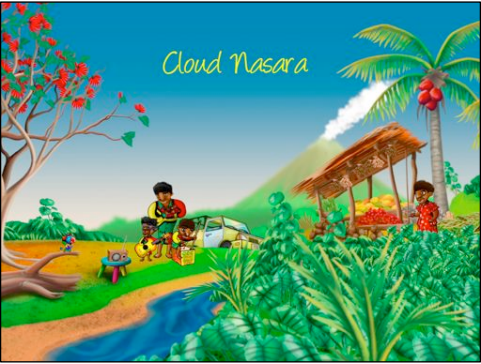
The Cloud Nasara Pacific Climate Animation Project aims to increase awareness of the science and impacts of climate variability in the Pacific, and to provoke discussion around how communities can take ‘low regrets’ actions to prepare for future El Niño and La Niña events and adapt to climate change. Cloud Nasara is an innovative new collaboration between Red Cross and the Australian Government’s Pacific-Australia Climate Change Science and Adaptation Planning Program (PACCSAP). The project is being implemented by the Red Cross, the Australian Bureau of Meteorology, the Commonwealth Scientific and Industrial Research Organisation (CSIRO), the Vanuatu Meteorology and Geo-hazards Department (VMGD) and the SPC-GIZ Climate Change Program.
Two short comical animation films are being developed as communication tools. One film will give an overview of climate processes and impacts in the Pacific region as a whole. The other film will be specifically focused on Vanuatu as a pilot country. They will be accompanied by a comprehensive ‘tool kit’ which will include resources to help facilitators link the information presented in the animation to decision making and action. The Cloud Nasara project is being developed through an ongoing consultative process, which includes research, focus groups, forums and direct communication with key stakeholders in Vanuatu and across the Pacific region. Cloud Nasara will be launched in June 2013. The films and accompanying resources will be useful for organisations, government, schools, and community groups in Pacific countries and by regional bodies across the Pacific and may assist those working in areas such as disaster risk management, health, food security, community planning, and environmental protection.
Contact: Ula Majewski – umajewski@meteo.gov.vu
NOTE: PROJECT OFFICIALLY ENDORSED BY THE NATIONAL ADVISORY BOARD ON CLIMATE CHANGE AND DISASTER RISK REDUCTION, 17 April 2013
Joint Workshop on DRR Lessons Learned in Vanuatu 2012
Workshop Objectives & Intended Outcomes
Objectives:
1. To compile a list of DRR activities conducted at the national, provincial, island, community and school levels in 2012
There is a corresponding video but not able to attach as it is too large to upload