: Climate change and rising sea levels and urbanization in low lying areas will increase the risk of coastal floods, erosion and salinization. Adaptation to reduce future environmental risks is inevitable, but it is unclear which coastal areas will be protected and in which regions residents will be forced to migrate. The EU-ERC COASTMOVE project aims assess how residents of low lying coastal areas can adapt and/or migrate to safer areas. For this, we aim to conduct surveys in 7 coastal areas such as Mozambique, Vietnam, Vanuatu, U.S.
To reduce the vulnerability of rural communities in Tonga,Vanuatu and Samoa to the impacts of Climate chnage,the proposed project will enable the transition from conventional to climate-resilient, regenerative agricultural (CRRA) practices. Through these practices, the delivery of agricultural ecosystem services will be enhanced and dependence on external inputs reduced.
To support the adoption of CRRA, the proposed project will:
- strengthen cross-sectoral partnerships
- enhance market incentives for CRRA
- Provide training and support for farmers and
- implement robust monitoring and knowledge-sharing initiatives to support learning and adaptive implementation of CRRA
Vanuatu is among the most vulnerable countries on earth to the increasing impacts of climate change, including climate-related natural disasters and the effects of slow-onset events such as sea-level rise and ocean acidification.
As the effects of global warming manifest and the hazards of climate change arise at accelerating rates, there is a need to shift the paradigm towards the standardised and mainstreamed use of science-based climate information, at multiple timescales, to support resilient development pathways.
The proposed project will support this paradigm shift through the strengthening and application of Climate Information Services (CIS) in five targeted development sectors: tourism; agriculture; infrastructure; water and fisheries.
More specifically, the project will build the technical capacity in Vanuatu to harness and manage climate data; develop and deliver practical CIS tools and resources; support enhanced coordination and dissemination of tailored information; enhance CIS information and technology infrastructure; and support the application of relevant CIS through real-time development processes, for more resilient outcomes.
The project has a focus on addressing information gaps and priority needs of target beneficiaries at national, provincial and local community levels across the five priority sectors.
The project will deliver enhanced:
- capacity and capability of national development agents, to understand, access and apply CIS
- CIS communications, knowledge products, tools, and resources for practical application to development processes.
- reliability, functionality, utility and timeliness of underlying CIS delivery systems and data collection infrastructure.
- scientific data, information and knowledge of past, present and future climate to facilitate innovated and resilient development.
Oxfam International is a world-wide development organisation that mobilises the power of people against poverty. In the Pacific, we work with our partners to ensure that Pacific Islander women and men (specifically those that are poor, marginalised or excluded) are leading and shaping their development and where their voices are heard and acted on by those in power. In the Pacific, Oxfam’s regional office is based in Suva, Fiji, where our Fiji country office and our base for remote cluster management of the Polynesia/Micronesia country office are also located. We also have offices in Papua New Guinea, Solomon Islands and Vanuatu.
The Pacific Islands Climate Change Collaboration, Influencing and Learning (PACCCIL) project is a four year (2018 – 2021) project funded for the first two years by Australian NGO Cooperation Program (ANCP). It aims at strengthening the influencing capacity of civil society actors and networks to ensure that action on climate change in the Pacific region is more effective, inclusive and collaborative. The project will work with key climate change action networks in Vanuatu and at the regional level, as well as facilitate the organising and collective action of civil society actors in Solomon Islands and the Polynesia and Micronesia sub-regions against climate change.
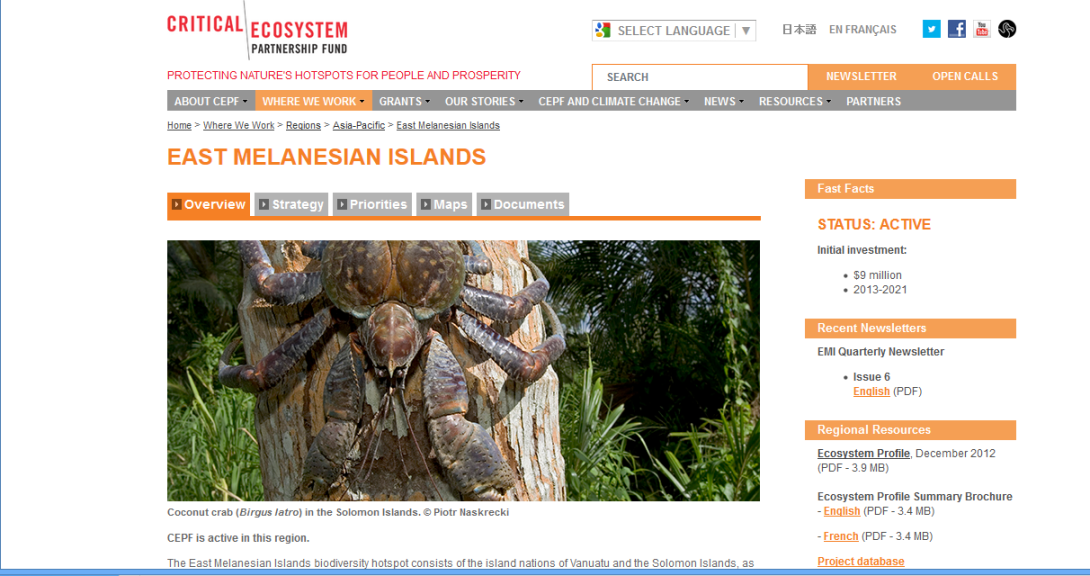
The Critical Ecosystem Partnership Fund (CEPF)2013-2021 is designed to safeguard the Earth’s biologically rich and most threatened regions known as biodiversity hotspots. It is a joint initiative of Conservation International (CI), l’AgencieFrancaise de Developpment (AFD), the European Union (EU), the Global Environment Facility (GEF), the Governemnt of Japan, the John D. and Catherine T. MacArthur Foundation and the World Bank. CEPF is a unique funding mechanism in that it focuses on high-priority biological areas rather than political boundaries, and examines conservation threats on a landscape scale. It is from this perspective that CEPF seeks to address conservation needs through coordinated regional efforts. Its fundamental goal is to ensure civil society is engaged in biodiversity conservation. CEPF’s US$9 million investment in the East Melanesian Islands hotspot was launched in 2013 and will continue until 2021. As we near the mid-term phase of CEPF’s investment in EMI (2017)
Vanuatu has been identified to be within the East Melanesian Islands Hotspot The hotspot is one of the most biologically important regions in the planet in terms of species richness and especially endemism. CEPF’s investment will be targeted where it can make the greatest and most sustained contribution to the conservation of globally important biodiversity.
An ecosystem profile for the hotspot was developed through a process of consultation and desk study led by the University of the South Pacific, various expert stakeholders, consultation processes and workshops .An outcome of the Ecosystem Profiling exercise was the development of CEPF’s Investment Strategy that received endorsement from national governments within the hotspot. The niche for CEPF investment was defined through an extensive process of stakeholder consultation supported by a detailed analysis of gaps and trends in conservation investment.
The CEPF Secretariat based in USA, is responsible for strategic and financial management, oversight, and reporting for the program. The CEPF Secretariat has the responsibility of managing CEPF large grants, of USD$20,000 or more.
The Regional Implementaion Team (RIT) provides strategic leadership for the EMI program. Their objective is to convert the plans in the CEPF ecosystem profiles into cohesive portfolios of grants. A critical aspect of the RIT will be making the CEPF program accessible to local and civil society organizations. IUCN’s Oceania Regional Office (ORO) is the RIT and is responsible for managing CEPF small grants of USD $20,000 or less.
IUCN Marine & Coastal Biodiversity in Pacific Islands Countries & Atolls Project (MACBIO) is supporting the Vanuatu Government achieve sustainable management of ecosystems and marine resources in country. Natural resources in marine and coastal areas are of high importance for Vanuatu and sustain the livelihoods of coastal communities. However, the need to use marine resources sustainably is not well reflected in national planning processes, due in part to insufficient information regarding their economic value and lack of concerted marine spatial planning.
MACBIO project 2013-2018 aims to help Vanuatu to meet their commitments under the CBD Strategic Plan 2011-2020 and the relevant Aichi targets, including the Programme of Work on Protected Areas (POWPA) and the Programme of Work on Island Biodiversity (POWIB) Specifically, the project aims to enhance ecosystem-based management and support more effectively managed marine resources which should lead to more resilient coastal and marine economies, more sustainable use of marine biodiversity, and will contribute to climate change adaptation and mitigation, as well as securing and strengthening local livelihoods. Tried and tested concepts and instruments will be adopted in Vanuatu.
The MACBIO project is being implemented by GIZ with technical support from IUCN-Oceania in close collaboration with SPREP.
. The IUCN components of the project aim to achieve the following outcome and outputs:
Outputs (specific project goals):
An ocean-wide policy and spatial planning framework
Through the project (within last year and this year 2016), Vanuatu has been able to develop a National Oceans Policy, which is currently awaiting official gazetting by the Council of ministers in July. In which the fundamental basis is founded upon Ecosystem based approach/management. As the vision of the Ocean Policy states;” To conserve and sustain a healthy and wealthy ocean for the people and culture of Vanuatu, today and tomorrow.”
The Policy was brought about by all relevant line government agencies pertaining to Oceans, but funded and facilitated through the MACBIO project. It includes several thematic areas (e.g Marine Protected Areas, Fisheries, Culture, Tourism, Shipping, Climate Change, DSM) but includes a new dimension, which is spatial planning for the sea. Marine spatial planning (MSP) with the aim to contribute to minimizing conflicts between different uses, promote sustainability of uses and conservation of some areas for biodiversity. In terms of MSP once the Oceans Policy is endorsed, the government will be mandated to carry out MSP, MACBIO has some expertise to share and will assist with this. At some point, Vanuatu Government decision-makers will have to think about what kinds of uses they would like to see in what parts of their sea and, to make informed decisions, they’ll need information about what is happening where. To help with this, the MACBIO project is trying to pull together data for the government to use. It will and has provided training to government officers, specifically fisheries officers in GIS and spatial mapping.
The economic value of marine and coastal ecosystem services is considered in national development planning.
MACBIO output: we have developed a Vanuatu Marine Ecosystem Service Valuation 2015 report. SUMMARY:This study, conducted in 2015, aimed to determine the economic value of seven marine and coastal ecosystem services in Vanuatu. The study forms part of the broader MACBIO project (Marine and Coastal Biodiversity Management in Pacific Island Countries and Atolls) that aims to strengthen the management of marine and coastal biodiversity in Pacific island countries.
The role that natural ecosystems, especially marine ecosystems, play in human wellbeing is often overlooked or taken for granted. The benefits humans receive from ecosystems, called ecosystem services, are often hidden because markets do not directly reveal their value – nature provides these benefits for free. Failure to recognize the role that marine ecosystems play in supporting livelihoods, economic activity, and human wellbeing has, in many instances, led to inequitable and unsustainable resource management decisions.
Coastal and marine resources provide Ni-Vanuatu businesses, households, and government many real and measurable benefits. The exclusive economic zone of Vanuatu, nearly 700,000 square kilometres of ocean, is more than 50 times larger than the country’s land area. This report, describes, quantifies and, where sufficient data is available, estimates the economic value of many of Vanuatu’s marine and coastal ecosystem services, in an effort to inform sustainable and equitable management decisions and support national marine spatial planning.
Seven key marine ecosystem services were evaluated in detail: subsistence and commercial fishing, tourism, coastal protection, carbon sequestration, minerals and mining, and marine research and management. Other services are explored as well, including cultural and traditional values associated with the sea, potential future industries and other human benefits that have not yet been developed or analysed. A scarcity of data about many of these ecosystem services prevents calculation of the total economic value, so the values below should be regarded as minimum estimates. Data gaps are described in detail in the full report.
Best practices for the management of marine protected areas, including payment for environmental services, and the resulting benefits, are demonstrated at selected sites.
This is still being implemented. With this project (proposed sites are Gaua, Torres and Nguna Pele)
Tried and tested concepts and instruments for the sustainable management of marine and coastal resource management are disseminated regionally and internationally.
Through the project this is being implemented. (proposed sites are Gaua, Torres and Nguna Pele)